Spotlight on: Excursions with Nicole Nassar, Coolaroo Educational Leader
A little bit about Nicole Nassar, Coolaroo Educational Leader
My name is Nicole Nassar. I’m Swedish with a Lebanese background, and I’m proud to be part of the leadership team at Kool Kidz Coolaroo, where I work as the Assistant Manager and Educational Leader. I graduated from Melbourne Polytechnic and have been working in the Early Childhood Education sector for over 13 years.
Throughout my career, I’ve taken on a variety of roles, but the positions I hold today are by far my favourites. They’ve given me a whole new perspective on all the roles I have been in and it has allowed me to make a meaningful impact by supporting educators, children, and families within our diverse community.
One of the areas I take great pride in is how effectively I plan and manage excursions. Ensuring children’s health and safety is always our top priority, and it’s incredibly rewarding to see these experiences come to life in a safe and enriching way. We take a lot of steps before we head on our way to our destinations!
Nicole’s process for organising an excursion?
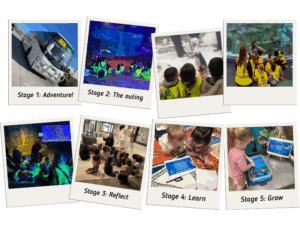
Our excursion planning process always begins with the children. Excursions are based on their interests, intentional teaching moments from our educators, or events from our calendar of events. For example, our recent excursion to Sea Life Melbourne Aquarium was inspired by the children’s strong interest in sea life and learning about how we care for marine habitats, a topic that was also supported by our calendar of events.
Once the idea is confirmed, we begin discussions with the team to decide which days are most suitable. After we contacted Sea Life aquarium and Bus company to request their risk assessment for school and kindergarten excursions. This is an important step before we create our own tailored risk assessment, as it helps us ensure that we have considered all potential risks and that the excursion is suitable for our service and age group.
After confirming the booking and conducting our own comprehensive risk assessment (aligned with the destination), we prepare and distribute excursion authorisation forms for families. I also create a social story for the children to help them understand what to expect and how to stay safe. These social stories are fun, engaging, and informative, and always include key safety messages such as:
- Road safety and awareness
- What to do if they encounter strangers or unfamiliar people
- The importance of wearing badges and high-vis vests
- Staying with their educators at all times and communicating if they need the bathroom
This is a vital part of our process and something we do for every excursion.
Each child is also given hi-vis vests an individual lanyard with our details, and those with medical conditions or dietary requirements are identified using a clear colour-coding system (e.g., red, blue, or green). Children are grouped according to educator-to-child ratios, and each group is colour-coordinated, so both educators and children know which group they belong to.
We organise a bus service to transport us to and from the venue. All drivers and volunteers are required to provide a current Working With Children Check (WWCC) which are also checked and sign our Code of Conduct. For family volunteers, we hold a briefing session where we cover essential information such as expectations around phone use and key elements from our risk assessment.
Barriers Nicole faces while organising an excursion and how she overcame them
One of the common barriers we encounter when organising excursions is managing casual bookings. Families often express interest in booking their child in casually just for the day of the excursion. However, due to the planning involved including pre-determined ratios, transportation arrangements, and safety procedures, we sometimes need to decline these requests if they exceed the capacity we’ve planned for. While we understand the disappointment, this may cause for some families, we always prioritise safety and we ensure our families understand why we cannot take them with us, however we do our best to rotate the days of the week we plan excursion and incursions to ensure there is fairness.
Learning on excursion and how this scaffolds the program
The children learned so much during our visit to Sea Life Melbourne. They discovered all kinds of marine animals and picked up some really interesting facts like how male seahorses are the ones who give birth!
Back at the service, this learning naturally flowed into the program. The children kept talking about what they saw and learned, even sharing their experiences at home. Educators picked up on this interest and created sea life-themed learning spaces in the kinder rooms to keep the interest going.
One of the highlights was when the Kinder room created a Story book about their excursion journey. It was added to the sea life area and placed in the book corner, and the children love going back to read and reflect on their adventure. It’s been a great way to extend their learning in a meaningful and engaging way.
Challenges and rewards from an excursion
One of the most challenging moments was managing the children’s excitement during transitions, especially when getting on and off the bus and moving through the aquarium. With so much to see and take in, it was important to keep the group together and focused while still allowing them to enjoy the experience. Having our clear group structure, colour-coded lanyards, and extra support really helped us manage this smoothly.
The most rewarding moment was seeing the children’s excitement when they saw the sea creatures for the first time especially those they’d never seen before, you can see how in tune they were. Their genuine curiosity, the questions they asked, and the way they continued talking about the excursion for days afterward showed us just how meaningful the experience was for them. Watching their learning come to life in such a real and hands on way made all the planning and preparation completely worth it, especially for me. Our families showing so much interest in supporting us during the excursions was super thoughtful and we are so grateful for all their support, getting their positive feedback in regards to their perspective in how much work goes into these outings. We also received amazing feedback from DE, which was super rewarding as well!
One piece of advice Nicole has for a service who is thinking about going on an excursion
My biggest piece of advice is to treat your risk assessment as the foundation of the entire excursion, it’s one of the most important parts of the planning process. Think carefully about the location you’re visiting, the route you’ll take, the children attending (including any medical needs or court orders), and how you’ll manage every part of the day.
We always say: it’s better to over-plan than under-plan. Over the years, I’ve learned that you can never be too prepared. I’d rather carry extra paperwork or items than be left without something important.
Approach it as if you’re running the day from your service, only now, you’re off-site. That means any essential information you would normally have access to (like action plans, court orders, or medications) must come with you. And it’s vital that every team member attending fully understands the risk assessment, not just the leadership team.
Our excursion backpacks always include:
- Court orders (if relevant)
- A current list of children attending
- Emergency contact details for all children
- A printed copy of the risk assessment
- Snacks, spare clothes, and sanitary items
Being well-prepared gives everyone peace of mind and lets you focus on what matters most which is creating a fun, safe, and memorable experience for the children! 😊